

Being off the grid is a great way to live. You can build your own homestead, create a sustainable living environment, and live according to an eco-friendly lifestyle. That being said, there are still some modern comforts that we all love and unfortunately need, with the internet being one of them. However, finding a reliable Internet connection when you are living off the grid can be very difficult, but that’s what we’re here to help with today. Let’s get right to it and talk about the six best ways to stay connected to the internet when you’re living off the grid.
Best Ways to Stay Connected – Off Grid Internet
From satellite internet and ham radios and more, let’s take a look at the 6 best ways to stay connected to the internet when living off-grid.
1. Satellite Internet

Perhaps one of the best ways to stay connected to the Internet when you are living off the grid is via satellite internet. This is a type of high-speed Internet that uses satellites to provide you with internet access. It’s very useful for those living in rural areas and in off grid conditions. It’s useful for places where traditional Internet providers won’t reach.
For a satellite internet connection, you’ll need to purchase a satellite dish, modem, router, and a few other pieces of equipment. Now, there are some big advantages to using satellite internet, with accessibility being one of them. As long as there’s a clear view of the sky, you should have internet virtually everywhere.
Satellite internet is also very fast, with speeds often comparable to cable Internet or DSL. Satellite internet also tends to be quite reliable as it doesn’t suffer from many infrastructure problems. However, video calls and games can be negatively affected due to the latency of 500 to 600 milliseconds required for the signals to travel. However, newer services can reach speeds of up to 100 megabytes per second, or even faster in some cases.
Furthermore, if you live in a rural area with a lot of inclement weather, such as heavy snow and rain, it may affect the satellite signal. On that note, due to its convenience and ability to function in rural areas, satellite internet can be very expensive, plus there are often data caps to consider as well. You’ll likely pay at least $500 to $700.00 for the equipment, as well as up to $150 for monthly fees.
The Starlink Satellite System
If you’re looking for one of the best and newest types of satellite internet, look no further than Starlink. Starlink is a constellation of satellites developed by none other than Elon Musk and SpaceX. The main goal of this system is to provide low-latency and high-speed interent to areas of the world where other types of internet are unreliable or unavailable.
At this time, the coverage provided by Starlink is near global. It will cost somewhere around $600, with a montly subscritpion fee that can top $100 as well.
There is even a premium service available known as Starlink Business, which costs roughly $500 per month and $2,500 to set up. Although this may be somewhat pricey, the fact is that the latency is only 40ms at most, and speeds are up to 150mbps. There are also constant upgrades being made, although weather remains an issue, as it does for all types of satellite internet.
2. Mobile Hotspots

To stay connected to the internet off the grid, another option at your disposal is to use a mobile hotspot. A mobile hotspot uses the cellular or data connection from your mobile device to provide you with Internet. All you need for this is either a smartphone that is able to make a hotspot or a mobile hotspot device.
To use these devices, all you need to do is activate them, whether on your smartphone or the device itself, and then connect your devices to the Wi-Fi network that is provided by said hotspot. The big bonus here is that a mobile hotspot can be used anywhere that you get a cellular signal.
So, if your smartphone works to make phone calls, it should also work to provide you with an Internet capable hotspot. The other big benefit of using a mobile hotspot is that it’s super portable. You can set it up virtually anywhere, and it really takes no knowledge to do at all, making it one of the best ways to stay connected off grid.
What you do however need to consider is that exactly how good your coverage is depends on the cellular network in question. Some cellular networks do not have great service in remote areas, so make sure to consider this. Also be sure to consider that many cellular services place data caps or data limits on their usage, and this can end up being quite expensive. With a lot of usage, data plans can be very expensive.
All of this being said, if you travel a lot or live in an area that has decent cellular coverage, and you need emergency or temporary internet access, then a mobile hotspot works just fine. However, for a more permanent and consistent connection that you’ll use on a daily basis, the satellite Internet above might be the better option for you.
3. Fixed Wireless Internet
To stay connected to the internet when living off the grid, using what is known as fixed wireless Internet might be a good option for you. Fixed wireless internet involves using a directional antenna to receive signals from a specific provider of fixed wireless internet. The external antenna is then connected to a receiver that captures the signal, which is then converted by the modem into a digital format, and finally distributed to your devices using a router.
The great part about fixed wireless internet is that the speed can be quite quick, often comparable to cable or DSL. The speeds can range up to 100 megabytes per second, although in some cases may be as slow as 10 megabytes per second.
What you need to realize is that not all areas are ideal for fixed wireless internet. For instance, one of the most important components here is that the antenna has a clear line of sight to the provider’s tower. This is one of the biggest downsides, because obstacles such as buildings, trees, and even extreme foliage can weaken the signal.
Now, fixed wireless internet tends to be more reliable than satellite internet, for instance, the latency is usually only up to 50 ms, which is substantially lower than with satellite internet. For this reason, fixed wireless internet is ideal for applications that require real time usage, such as for online gaming and video calls. If you live within range of a fixed wireless service provider’s tower, then you are in luck.
4. Long Range Wireless Internet (WIFI)
The next option you have at your disposal to stay connected to the internet when living off grid is to use long range wireless internet, or long-range Wi-Fi. For this, you’ll need some long-range Wi-Fi antennas, directional antennas that can capture and focus wireless internet signals over long distances. To help amplify the signal and to receive it from greater distances, you’ll also need repeaters and extenders, as well as a standard Wi-Fi router.
The trick here is that these long-range wireless internet antennas can capture Wi-Fi signals over great distances. This means that first and foremost, you need to point the antenna in the right direction, whether it be to a neighbor’s Internet network, a business that has free Wi-Fi, or even a public hotspot.
Once you’ve determined the direction to point the antenna in, you can then set it up. Make sure that there are as few obstacles in the way as humanly possible. If there is a significant distance between the antenna and the source of the Wi-Fi, you’ll certainly want to use a repeater.
Now, although the equipment may cost you a bit of money, using long range Wi-Fi can be much more cost effective than using fixed wireless or satellite internet, making it one of the best ways to stay connected off grid that won’t cost you an arm and a leg. This is especially the case if you have easy access to a shared network or an open network. Moreover, the speeds can be pretty decent, and are usually suitable for basic use.
However, what needs to be said is that the connection quality isn’t always great, as it can be influenced by distance. You also need to consider that a variety of open networks may also pose security risks to you, because your data is at risk of being accessed by other parties.
5. Ham Radio Internet
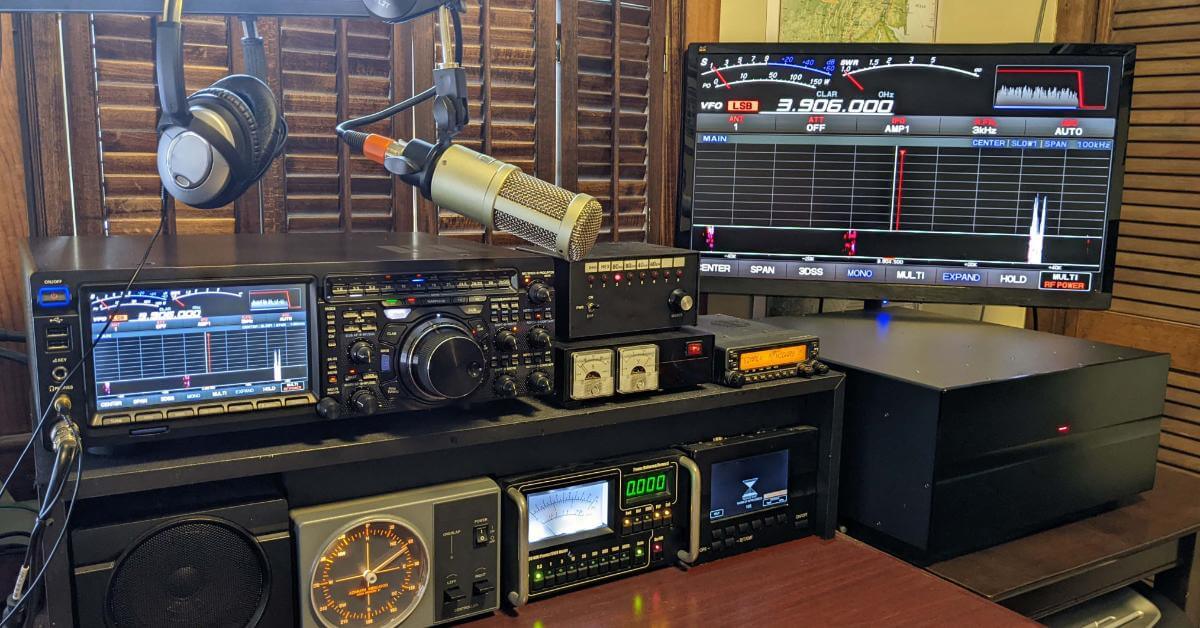
By far one of the most interesting ways to get internet service when you live in an off-grid situation is to use a ham radio via the AMPRNet. Without getting too technical about it, a ham radio is able to receive both radio and Internet signals thanks to special types of software.
The initial setup can be relatively expensive, because you need to purchase ham radio equipment, a terminal node controller, you need to have a computer, and you need to have the right software too. You’ll need to set up the ham radio equipment and then connect it to a computer using the terminal node controller. You’ll then also have to set up the software so that it can connect to AMPRNet.
For beginners, this can be a relatively challenging process, although it is ideal for those who are amateur radio enthusiasts. This type of internet has a lot of community support among those who are ham radio enthusiasts. Another benefit of ham radio internet for off grid situations is that it works in extremely remote locations where most other types of internet just can’t work.
With that being said, one of the biggest drawbacks here is speed, or a lack thereof. Ham radio internet is really only suitable for the most basic of internet purposes, such as text-based browsing or emails. What you also need to realize is that you require an amateur radio license in order to use this kind of Internet, which can also cost a good deal of money.
6. Using Community Networks

Depending on where you live, you may also have access to a community network. Here, multiple households in an off grid setting that live close enough to each other may be able to use Wi-Fi technology to spread the Internet signal across a large area.
It’s ideal for rural communities. This involves the use of mesh networking technology, where each person has systems in place that can receive and send Internet signals from and to various sources.
It’s a great option due to having a low monthly bill. The cost of the equipment and the Internet service itself can be shared among multiple people, and resources can be pooled together. Many often use solar setups to reduce energy costs as well.
Another positive is that it’s very expandable and scalable, and depending on where exactly nodes are positioned, it can change the strength of the signal in various areas of the community. However, the initial setup and getting the coverage right can be a big challenge. Furthermore, because there are multiple people connected to a single network, it means that the bandwidth is also extremely limited.
Considerations When Choosing from The Best Ways to Say Connected Off Grid
Before you choose any one of the above off grid internet options, there are some important considerations that you should keep in mind. These are the considerations you need to make when choosing the best way to stay connected off grid,
Location
Perhaps the most important consideration of all here is terrain and location. For instance, there are some types of Internet, such as wireless and long range Wi-Fi, that require a good line of sight to the provider for a solid connection. Obstructions like trees, mountains, hills, and buildings can pose a big problem. You may also want to consider your climate and regular weather conditions, as fixed wireless Internet and satellite Internet can both be affected by the weather.
Internet Requirements
You then also need to consider what your Internet usage requirements are, and how many people you want to have connected. For instance, if you need something with low latency, such as for live applications, then satellite internet might not be best. If you need to download a large amount of files, engage in gaming, video conferencing, and streaming, then you’ll need something that allows for high data limits and a higher bandwidth.
Overall Performance
This is related to the above, but keep in mind that not everybody has the same requirements. Maybe you just need to check an e-mail or browse the web, or maybe you need to play some real time shoot em up games that require a whole lot of bandwidth. Therefore, you need to consider the speed, latency, and reliability of all possible options.
Coverage
Of course, when choosing a type of off grid Internet, you need something that’s actually available in your area. Therefore, you need to do some research in terms of which technologies and Internet providers can be accessed in your area. It’s a good idea to take a look at some coverage maps to figure this out.
Installation and Costs
Although we aren’t about to do a direct cost comparison between all of the off-grid Internet methods we’ve listed above, you do need to consider what the initial or upfront setup costs are, what the monthly fees are, and if there are any long-term costs, that is for maintenance.
Speaking of installation, not all types of off grid Internet are as easy to install as others. Therefore, you want to consider whether it’s a type of Internet that you can install yourself or if you’ll need a professional to help, as this can also contribute to the overall cost.


